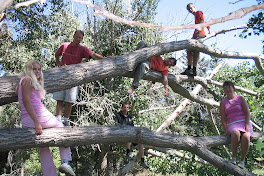
Life is a gift to be used every day,
Not to be smothered and hidden away;
It isn't a thing to be stored in the chest
Where you gather your keepsakes and treasure your best;
It isn't a joy to be sipped now and then
And promptly put back in a dark place again.
Life is a gift that the humblest may boast of
And one that the humblest may well make the most of.
Get out and live it each hour of the day,
Wear it and use it as much as you may;
Don't keep it in niches and corners and grooves,
You'll find that in service its beauty improves.
Friday, December 5, 2008

Monday, November 3, 2008

Friday, October 31, 2008
Home- the happiest place in the world
"It was the policy of the good old gentleman to make his children feel that home was the happiest place in the world; and I value this delicious home-feeling as one of the choicest gifts a parent could bestow." excerpt from "Christmas Eve" by Washington Irving
Beneath the Skin
The following is a long read, but oh, so important! My daughter and I have embarked upon our "Esther Year" (taken from a book called Queen Esther's Secrets of Womanhood: A Biblical Rite of Passage for Your Daughter by Ginger Garrett) as I attempt to build mother/daughter memories with her as well as instill in her that she is beautiful, made in the image of God. I believe we all need to be reminded of this as we are bombarded by the lies of Satan in this world.
Beneath the skin
By Walt Mueller
Walking through the mall with my wife can be dangerous. This time, her elbow in my side—accompanied by the admonition to “keep walking and looking straight ahead”—was justified. Lisa’s move into the preventive mode was almost reflexive. Like most good wives, her reflex was rooted in understanding four ingredients that have combined in an all-too-often lethal combination that’s killing people and relationships in today’s world: 1) maleness; 2) the universal scope of human depravity; 3) our culture’s obsession with outward appearance; and 4) the fact that we just happened to be walking past Victoria’s Secret, which at our mall, incidentally, sits directly across from the store most-frequented by kids—the Build-A-Bear Workshop.
On this particular day (like all other days), the sparkling floor-to-ceiling windows at
Where we are
This got me thinking. I’m a 51-year-old man who’s been hammered by a lifetime of visual images that have combined to define personhood, maleness, femaleness, how to view myself, how to view a woman and what makes a person valuable. I’m also a Christ-follower who has consciously sought to understand how the Gospel and a biblical world and life view counters this message—a message that by the way, I can choose to accept or reject—with the Truth. Even with all my years of life-informing faith, my accumulated wisdom, my conscious resolve and elbows in the side, I still find my heart and mind are battlefields over these issues. It’s the
Last year, the folks at the Dove Soap Campaign for Real Beauty released another in their line of thought-provoking video ads that cut to the heart of our culture’s appearance obsession. Dubbed “Onslaught,” a shot of a young girl’s innocent face is followed by a volley of sexually charged advertising images for diets, exercise, cosmetics and plastic surgery. The message at the end? “Talk to your daughter before the beauty industry does.”
In today’s world, our identity is wrapped up in what we look like. You are what you look like. And what you look like (i.e. sex appeal) determines not only your value and how others think of you, but how you think of yourself.
While each of us has grown up with this pressure, it’s still a relatively new thing. My two grandmothers lived their teen years when the last century was young. The blitz of post WWII marketing was still years away. Marketing existed in the print media of the time, but it was more about selling goods and services than about selling image. Visual broadcast media was non-existent. If my grandmothers were ugly, they didn’t know it. Why? Because media-defined standards didn’t exist for the simple reason that media as we know it today was yet to be born.
By the late 1950s and 1960s, a booming post-war economy combined with the expansion of the media machine (think television) to not only change the world, but to establish standards to “help” us discern beauty from unsightliness. As my mother and the maternal peers of her time raised their children, they were being hammered with ads like the one for Warner’s “Concentrate Girdle” and “Little Fibber” bra that picture a pear, along with the text, “This is no shape for a girl.” Or take the ad for Formfit Rogers pantyhose, where the text over a “perfectly-shaped” female form tells readers to “Be Some Body.” It only got worse for my wife and her peers.
In today’s world, my two daughters and the girls you know and minister to are at least two generations removed from female relatives who grew up in a world largely void of this pressure, who—as a result—didn’t have to struggle the way our girls do today. Print media, broadcast media and the Internet shape that supermodel image that’s become an all-consuming passion and pursuit in today’s culture.
But it’s not just our girls. My two boys have grown up in a culture that has sent them impossible-to-miss messages about the skin-deep attributes that not only make a female valuable, but worthy of their time and attention. These attitudes are multi-generational as well. Before I entered my own teenage years, The Okaysions had me and my male peers singing, “I’m a girl watcher, I’m a girl watcher, watching girls go by, my my my … I was just a boy, when I threw away my toys, and found a new pastime to dwell on.” To our boys, girls are less and less people, and more and more objects to be ogled and used. On top of that, more and more of our boys are defining themselves by outward appearance and/or athletic performance. An estimated 10 to 15 percent of people with anorexia or bulimia are male, and the use of performance enhancing drugs (including steroids) is widespread.
What should we make of it?
If we look realistically at our cultural obsession with what lies on the outside, there are some realities that we must recognize and understand before framing a ministry response.
First, it’s not getting any better. Sure the folks at Dove are speaking up. And, there are a growing number of voices saying, “Enough is enough!” But the fact remains that these attitudes are so well-entrenched in our collective consciousness that it will take much more than a few Dove ads or outspoken critics to release the strangle-hold this stuff has on our hearts and minds. Not only is it not going to go away any time soon, but it’s a cancer spreading like wildfire. As long as there are people who define themselves by what lies on the outside, who are horribly dissatisfied with what they see in the mirror, and who are willing to spend money in an effort to remedy their image anxiety, it’s only going to get worse. Face it, we’ve grown up believing that human value and worth—both our own and others’—lies solely in what we look like on the outside. While we’d love to deny it, this belief has become a foundational tenet of our collective worldview.
Second, at its root, this is an issue of idolatry. Anything that consumes our time, thoughts, resources and energies other than the one true God is idolatry. The fact that the first two commandments God uttered cut right to the heart of the matter of idolatry indicate just how easy it is to get our eyes and allegiance off the Creator and onto created things. “You shall have no other Gods before me” and “You shall not make for yourself an idol in the form of anything in heaven above or on the earth beneath or in the waters below” are right on the mark. If we want to discover our culture’s golden calf, we don’t need to look any further than the images we wrestle with in our own mirrors, or the faces and bodies on magazine pages that attract our longing, lustful and jealous stares.
Third, we must think theologically about the realities that exist. This cultural reality doesn’t exist in a vacuum. It’s a presence in our world that’s woven in and through God’s continually unfolding Divine drama. The perfect created order has crumbled due to human rebellion. We are still naked and ashamed, including being ashamed of what we see in the mirror. In an effort to appease our own insecurities, we pour loads of shame on those who don’t measure up in our eyes. Perhaps even worse, our kids are being socialized into a world where they are taught that it’s right and proper to feast your eyes on the nakedness of those whose appearance measures up to our culturally defined standards of beauty, as if indulging in these things will somehow bring fulfillment and redemption. In the end, it’s all a futile pursuit, as the only way the Fall that undid God’s perfect Creation can itself be undone is through God’s provision of Himself as the Redeemer, through His Son Jesus Christ. In today’s youth culture, perhaps the greatest diversionary weapon in the enemy’s hands is our obsession with the skin-deep self.
How should we respond?
To choose not to understand and respond to these realities is to not only fail in our parenting and youth ministry callings, but to fail our kids. What are some steps we can take to begin to undo what’s been done?
First, we must teach a theology of the Fall. There’s a reason why time and gravity are not kind to the human body. God’s perfect order has come undone. Life in a post-Genesis 3:6 world is a cursed life marked by death, disease and suffering. Feeling immortal and invulnerable, our teenagers rarely gain a perspective that helps them understand that while every new day is filled with opportunity for service to the Kingdom, it also means we’re one day older and one day closer to physical death. Hair turns gray—or falls out. Organs break down. Wrinkles appear. Waistlines expand. Yet the multi-billion dollar cosmetic/weight-loss/plastic surgery industry continues to grow. One recent Sunday morning I turned on my TV as I was getting dressed and ready for worship. As I flipped through the channels it struck me that on this day dedicated to worship of the Redeemer, more than one-third of the stations were running infomercials for exercise machines, weight-loss plans and age-reducing cosmetics. What I saw reminded me of a two-page print-ad for Botox that I stumbled upon in Entertainment Weekly a few years ago. There was a picture of a good-looking 50-something married couple who were obviously still enamored with each other. The ad read, “We promised to grow old together, not look old together.” We just don’t get it do we?
Second, we must help them understand that their identity lies in who they are as God’s created beings, and that they can only find their security in who they are in Christ. We all will get old. Our bodies will show signs of aging. Few if any of us will ever come close to looking like the manipulated images that command our worship and shape our aspirations for ourselves. We need to teach our students that no matter how much time, money and effort they put into reaching the standard, they’ll never make it. It is only when they find their identity in Christ that they will be freed from the belief that personal worth is tied to appearance. They are lovable, worthwhile and valuable regardless of what they look like. God loves his fearfully and wonderfully made children just the way they are. Understanding and embracing this reality frees us from the pressure that we place on ourselves and on others.
Third, we need to live lives that are more than skin deep. Let’s face it, there’s not a single one of us who doesn’t deal with this pressure on a daily basis. How we handle and respond to the pressure in our own lives will go a long way in teaching our kids to do the same. It’s a classic case of actions speaking louder than words. In addition, we must be careful to love all students God places in our lives, regardless of where they stand on our culture’s appearance-based pecking order. Do you play favorites with the beautiful people who have been entrusted by God to your care? No really, think about it. It happens. Our calling is to see our students as God sees them—the same God who doesn’t look at the outward appearance, but rather, who looks on the heart (I Sam. 16:7).
While watching a recent episode of The First 48, I did something shameful. The reality police show featured a lead investigator who at some point in his life had been horribly burned. His face and head were so terribly disfigured that he had no hair, and his ears and nose had been obviously reconstructed to look as close to real as possible. I found myself questioning how he could function. Ultimately, I was questioning his humanity based on his appearance. Shame on me. It reminded me of that pivotal line in the film The Elephant Man, where an ostracized and frustrated John Merrick cries out a message to all who would judge themselves or another by their outward appearance—“I am not an animal! I am a human being! I am … a man!”
If only our kids would begin to realize this about themselves and others.
For more information on resources to help you understand today’s rapidly changing youth culture, contact the Center for Parent/Youth Understanding.
©2008, The Center for Parent/Youth Understanding
Friday, October 24, 2008
Our Amazing God!
The following is very interesting. It is talking about laminin (it almost sounds like Lammiman!) and shows just how amazing our God is!
Monday, October 20, 2008
Learning about the World of Teens
Greg and I attended an awesome conference this weekend, called Re.verse. Actually, all four of our kids were also in attendance at the youth portion of the same conference. My only regret is that more parents did not take advantage of this teaching.
Chap Clark spoke on parenting teens. He is a father, youth pastor, college professor and researcher of youth and youth culture. Unlike so many speakers on youth, I was pleased to hear him stress that our children WANT and need us to be involved in their lives and to love them. He also said, “...we have been given the ultimate task of making sure our kids have the best and clearest chance to get close to Jesus, the One to whom they ultimately belong. We must do whatever it takes to get any hindrance out of the way of them encountering the true, alive, and real Jesus. That single calling summarizes your job as a parent. The point of parenting, after all is said and done, is making sure your child has had the best and clearest opportunity to get up close and personal with their Creator.” I liked this guy!
Who has God created our kids to be? Our job is to help them become a healthy individual, to find THEIR calling- absolutely unique to them.
Chap started out explaining how adolescence is relatively new. In the pre-1900s, children went from childhood into adulthood without an in-between phase. They hit puberty at an average age of 14.5 and were considered adults at age 16. In the 1980s, studies showed that children were hitting puberty at around 13 years of age and entered adulthood at between 18 to 20 years of age. Today, puberty is happening on an average age of 12 and it isn’t until the mid to late 20s that equivalent adulthood is reached. Today's 23 year old is equivalent to a 17 year old 20 years ago!
Adolescence is lengthening, and not just in our western countries, but all over the world, in every culture. One reason, among many, is because our kids feel there is nothing left for them to shoot for; innocence has been stolen from them at an early age. Another reason has to do with adult’s agendas. For example, sports. Initially, children grew up in tight knit communities where they were affirmed, disciplined and looked out for by everyone around them, Parents were ultimately in charge, but everyone had a vested interest in seeing the children in their community become healthy, productive adults. Stories were shared and passed from generation to generation. Chap gave the example of dance. Its purpose originally was a way of telling a story. It created community. Today, however, we have competitive dance, really an oxymoron, because the object is now to beat your opponent- this cannot and does not promote community. It also becomes more about the adult instructor’s agenda (not to mention the parent’s) rather than the child. The child is pressured to dance to the instructor’s rules and expectations. The first organized sports for children were created in the 1930s. Chap says we’ve made our kids modern day gladiators.
Another reason for lengthening adolescence is education. In the 1930s, high school became mediatory. It became more about socialization and how to assimilate kids into adulthood. Today, granted there are good teachers, education as a whole has become more about the adult fulfilling his agenda and not about the individual child.
Another factor is the family itself. The family tree pre-1930s looked much different than today. It was basically dad, mom, kids, grandparents, uncles, aunts, cousins. Today, a child deals with the confusion of real dad, real mom, step dad, step mom, real sibling, step sibling, etc. Even for those children raised today with a “normal’ family tree, they are seeing all around them the realities of the expected confusion of a very mixed up family tree.
Studies also show that parents spend 40% less time with their kids than parents 30 years ago. Today’s kids have been abandoned. They become egocentric because they are abandoned.
Because of the hurt and confusion kids feel today, they have created what Chap Clark terms “The World Beneath.” They live in layers and operate out of multiple “identity candles” -choosing an identity safest for them in any given environment. They can’t put the candles together thus creating multiple personalities. As different agendas are imposed on them, they feel they are welcomed when and if they portray an image that is pleasing enough to be accepted.
Kids today have the phenomenon of clusters- friends for self-protection (not true friends though they think they are). The rule of the cluster is to protect each other. They will choose the cluster over family. However, they don’t WANT to hurt you, their parents. Therefore, they will ‘lie’ to protect you- rationalizing that it isn’t a lie for the good of protecting you.
These kids are the “stressed generation.” They have pain we can rarely see. They may respond “I’ve got it handled!” but what they are really saying is “I don’t want and can’t handle another agenda.”
The task of adolescence is about three things: identity (Who am I?), autonomy (Do I/my choices matter?), and belonging (Where do I fit?). Chap encouraged us to invite our child to teach us about their world.
What every adolescent needs...
Family safety and stability- emotional, intellectual, physical. A safe haven. Allow them to argue their faith without letting your agenda get in the way. They need to test it to make it their own. 50% of those who bail on their faith are those who were strong in youth group but felt they were never allowed to test/question. We are called to be gentle, nurturing, to build an environment of trust, closeness and communication. The bottom line for kids is the question: Is there anyone who cares?
Be understanding. Demonstrate compassion (it means to “suffer with”). Become a student of your children and his friends. Every person we meet is an opportunity. We can build them up or tear them down- never is there neutrality.
Provide boundaries, a forward looking environment where kids learn and grow. Three keys to setting boundaries:
1) The dance of negotiation. This develops their personal power which is the most important thing to give them. It allows our kids to know they are “wantable.” Every kid needs a different set of boundaries. We need to encourage power but still be in control. DO THIS WITH RESPECTFUL DIALOGUE.
2) The tapestry of consequences. Consequences of breaking boundaries must be related to learning and growing from the situation.
30 The drama of authentic relationships. Studies show that the healthiest kids are good friends with their parents. LIKE your kids and let them know you do!
Developing adolescent faith is about helping them to find their personal calling. We must do this with gentleness (1Thess. 2:7-8). We need to remember that human and spiritual development stages are related. I Thess. 2:11-12 says to give encouragement and comfort, and to be a FAN! (not a coach). We need to create a faith parenting community, a convergence of at least five caring adults that are crazy about our child.
Chap Clark spoke on parenting teens. He is a father, youth pastor, college professor and researcher of youth and youth culture. Unlike so many speakers on youth, I was pleased to hear him stress that our children WANT and need us to be involved in their lives and to love them. He also said, “...we have been given the ultimate task of making sure our kids have the best and clearest chance to get close to Jesus, the One to whom they ultimately belong. We must do whatever it takes to get any hindrance out of the way of them encountering the true, alive, and real Jesus. That single calling summarizes your job as a parent. The point of parenting, after all is said and done, is making sure your child has had the best and clearest opportunity to get up close and personal with their Creator.” I liked this guy!
Who has God created our kids to be? Our job is to help them become a healthy individual, to find THEIR calling- absolutely unique to them.
Chap started out explaining how adolescence is relatively new. In the pre-1900s, children went from childhood into adulthood without an in-between phase. They hit puberty at an average age of 14.5 and were considered adults at age 16. In the 1980s, studies showed that children were hitting puberty at around 13 years of age and entered adulthood at between 18 to 20 years of age. Today, puberty is happening on an average age of 12 and it isn’t until the mid to late 20s that equivalent adulthood is reached. Today's 23 year old is equivalent to a 17 year old 20 years ago!
Adolescence is lengthening, and not just in our western countries, but all over the world, in every culture. One reason, among many, is because our kids feel there is nothing left for them to shoot for; innocence has been stolen from them at an early age. Another reason has to do with adult’s agendas. For example, sports. Initially, children grew up in tight knit communities where they were affirmed, disciplined and looked out for by everyone around them, Parents were ultimately in charge, but everyone had a vested interest in seeing the children in their community become healthy, productive adults. Stories were shared and passed from generation to generation. Chap gave the example of dance. Its purpose originally was a way of telling a story. It created community. Today, however, we have competitive dance, really an oxymoron, because the object is now to beat your opponent- this cannot and does not promote community. It also becomes more about the adult instructor’s agenda (not to mention the parent’s) rather than the child. The child is pressured to dance to the instructor’s rules and expectations. The first organized sports for children were created in the 1930s. Chap says we’ve made our kids modern day gladiators.
Another reason for lengthening adolescence is education. In the 1930s, high school became mediatory. It became more about socialization and how to assimilate kids into adulthood. Today, granted there are good teachers, education as a whole has become more about the adult fulfilling his agenda and not about the individual child.
Another factor is the family itself. The family tree pre-1930s looked much different than today. It was basically dad, mom, kids, grandparents, uncles, aunts, cousins. Today, a child deals with the confusion of real dad, real mom, step dad, step mom, real sibling, step sibling, etc. Even for those children raised today with a “normal’ family tree, they are seeing all around them the realities of the expected confusion of a very mixed up family tree.
Studies also show that parents spend 40% less time with their kids than parents 30 years ago. Today’s kids have been abandoned. They become egocentric because they are abandoned.
Because of the hurt and confusion kids feel today, they have created what Chap Clark terms “The World Beneath.” They live in layers and operate out of multiple “identity candles” -choosing an identity safest for them in any given environment. They can’t put the candles together thus creating multiple personalities. As different agendas are imposed on them, they feel they are welcomed when and if they portray an image that is pleasing enough to be accepted.
Kids today have the phenomenon of clusters- friends for self-protection (not true friends though they think they are). The rule of the cluster is to protect each other. They will choose the cluster over family. However, they don’t WANT to hurt you, their parents. Therefore, they will ‘lie’ to protect you- rationalizing that it isn’t a lie for the good of protecting you.
These kids are the “stressed generation.” They have pain we can rarely see. They may respond “I’ve got it handled!” but what they are really saying is “I don’t want and can’t handle another agenda.”
The task of adolescence is about three things: identity (Who am I?), autonomy (Do I/my choices matter?), and belonging (Where do I fit?). Chap encouraged us to invite our child to teach us about their world.
What every adolescent needs...
Family safety and stability- emotional, intellectual, physical. A safe haven. Allow them to argue their faith without letting your agenda get in the way. They need to test it to make it their own. 50% of those who bail on their faith are those who were strong in youth group but felt they were never allowed to test/question. We are called to be gentle, nurturing, to build an environment of trust, closeness and communication. The bottom line for kids is the question: Is there anyone who cares?
Be understanding. Demonstrate compassion (it means to “suffer with”). Become a student of your children and his friends. Every person we meet is an opportunity. We can build them up or tear them down- never is there neutrality.
Provide boundaries, a forward looking environment where kids learn and grow. Three keys to setting boundaries:
1) The dance of negotiation. This develops their personal power which is the most important thing to give them. It allows our kids to know they are “wantable.” Every kid needs a different set of boundaries. We need to encourage power but still be in control. DO THIS WITH RESPECTFUL DIALOGUE.
2) The tapestry of consequences. Consequences of breaking boundaries must be related to learning and growing from the situation.
30 The drama of authentic relationships. Studies show that the healthiest kids are good friends with their parents. LIKE your kids and let them know you do!
Developing adolescent faith is about helping them to find their personal calling. We must do this with gentleness (1Thess. 2:7-8). We need to remember that human and spiritual development stages are related. I Thess. 2:11-12 says to give encouragement and comfort, and to be a FAN! (not a coach). We need to create a faith parenting community, a convergence of at least five caring adults that are crazy about our child.
Thursday, October 2, 2008
Youth Ministry in an Age of Delayed Adulthood
Youth Ministry in an Age of Delayed Adulthood
This is an interesting and relevant article. Please read it. Chap Clark is coming to Calgary October 17-18 and speaking at the Re.verse Conference.Here is the article: share
Posted using ShareThis
Subscribe to:
Posts (Atom)